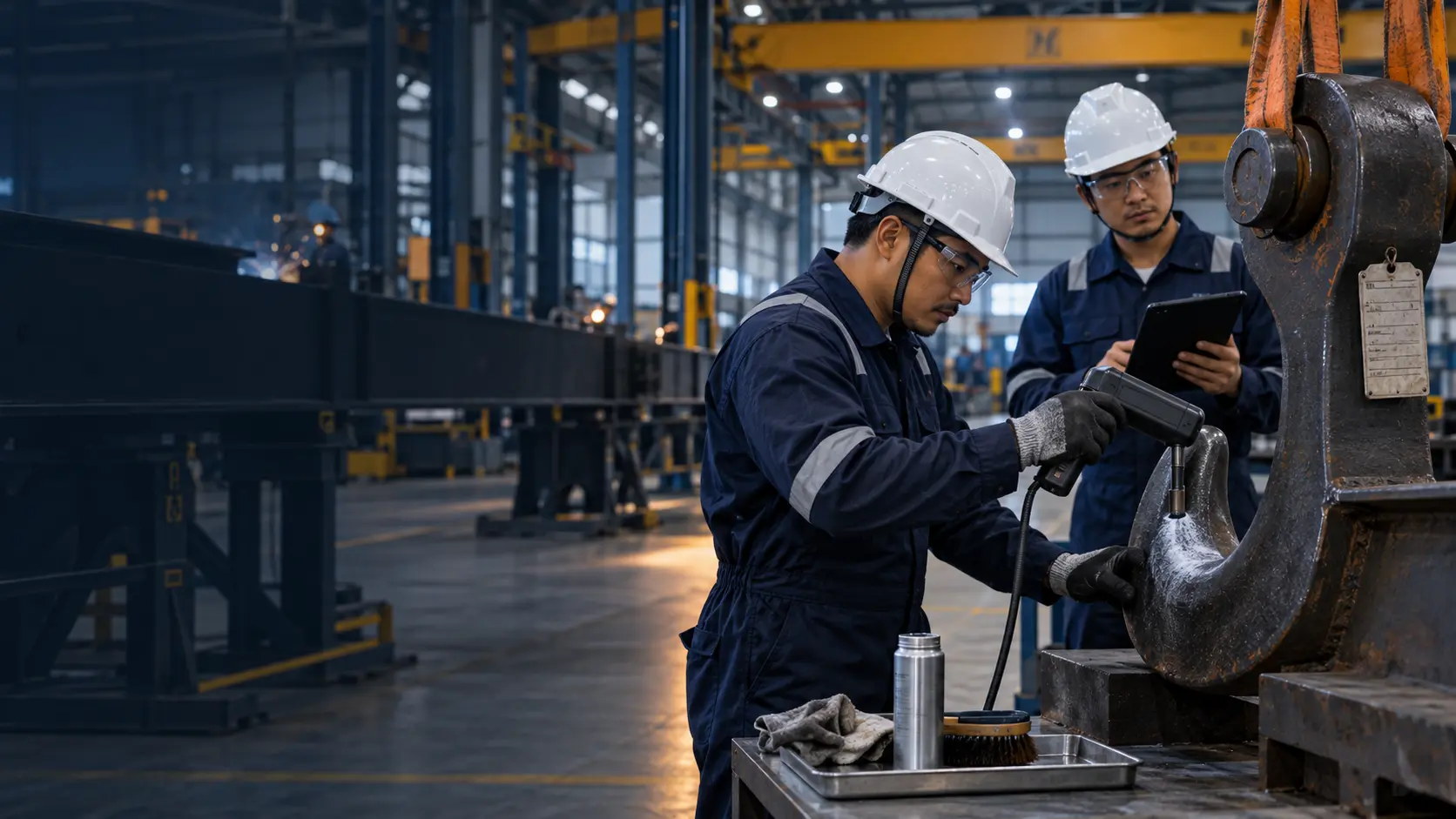
Industrial inspectors examining a steel lifting component in a fabrication workshop

Industrial inspection · International reach

Find the flaw.
Protect the asset.

Malaysia-based inspection support for critical surfaces, lifting equipment and manufactured assets—available for local and selected international projects.

  • Magnetic particle testing
  • Penetrant testing
  • Lifting equipment inspection
  • International project deployment
Scope-ledMethod selected against your asset and acceptance criteria
Competence-ledPersonnel assigned according to method and project requirements
Evidence-ledAsset identification, findings and inspection records kept clear

Core capabilities

Inspection built around the risk—not a generic checklist.

TRANS coordinates assignments in Malaysia and selected international locations, from scope review through field inspection and reporting. Our initial technical focus is surface-breaking defect detection and the condition of lifting and handling equipment.

02

Liquid Penetrant Testing

Surface examination for non-porous materials, including stainless steel, aluminium and non-ferromagnetic components.

  • Visible or fluorescent penetrant
  • Fine crack and porosity detection
  • Portable on-site application
DetectsFlaws open to the surface
03

Lifting & Handling Equipment Inspection

Condition assessment, identification checks and targeted NDT for lifting accessories and equipment, based on the agreed scope and applicable client criteria.

View equipment coverage
04

Vendor & Third-Party Inspection

Independent witnessing and verification at the manufacturer or project site, including identification, documentation and final condition checks.

Discuss your inspection point

Lifting integrity

Know what is fit for continued use.

We help asset owners build a defensible picture of equipment condition—matching each item to its identity, observable condition and required examination.

1

IdentifyEquipment ID, capacity, markings and traceability

2

ExamineVisual condition and agreed NDT locations

3

ReportFindings, limitations and required follow-up

Typical equipment coverage

Chain blocks Lever hoists Wire-rope slings Webbing slings Shackles Lifting hooks Lifting beams Spreader beams Overhead cranes Material hoists
Important scope note

Statutory inspection, proof-load testing and regulatory certification are undertaken only where specifically agreed and delivered by appropriately qualified or registered personnel. The quotation will state the exact service status.

Where we work

Industrial sectors with assets that cannot be left to assumption.

01

Manufacturing & Fabrication

Welded structures, lifting accessories, machinery components and final product checks.

02

Palm Oil & Bioenergy

Mill lifting equipment, process-area components and maintenance inspection support.

03

Oil, Gas & Petrochemical

Project-specific surface inspection and vendor surveillance through assigned competent personnel.

04

Warehousing & Logistics

Handling equipment, hoists, lifting accessories and traceable asset registers.

05

Marine & Ports

Lifting gear and fabricated components subject to defined client and regulatory requirements.

06

Utilities & Infrastructure

Fabrication and maintenance inspection for critical steel components and lifting systems.

How an assignment runs

One controlled line from scope to close-out.

No ambiguous certificate promises. Before mobilisation, we confirm the asset, inspection method, acceptance criteria, reporting requirement and whether any statutory recognition is required.

  1. 01

    Scope review

    Asset list, location, material, access and required standard.

  2. 02

    Technical plan

    Method, personnel, equipment and acceptance criteria confirmed.

  3. 03

    Mobilisation

    Site arrangements, safety requirements and inspection points agreed.

  4. 04

    Inspection

    Items examined, identified and recorded against the approved scope.

  5. 05

    Report

    Findings, limitations and required follow-up issued clearly.

Technical governance

Credibility starts with saying exactly what the inspection covers.

Competence by scopeInspectors are assigned against the required method and equipment category.

Controlled equipmentApplicable equipment status and checks are confirmed before use.

Defined criteriaAcceptance criteria are agreed before findings are classified.

Transparent statusAccredited, statutory and non-statutory status is stated only where applicable.

Before you request a quote

A clearer scope gives you a faster answer.

Send the asset type, quantity, location and required inspection date. Include the applicable code or customer specification where available.

What is the difference between MT and PT?

MT can detect surface and some near-surface discontinuities, but only in ferromagnetic materials. PT detects discontinuities open to the surface and can be used on a wider range of clean, non-porous materials.

Does lifting inspection automatically include JKKP certification?

No. A condition inspection is not automatically a statutory inspection. Where regulatory approval is required, the necessary registration, competent-person involvement and exact deliverable must be confirmed before quotation.

What information should we provide?

Provide the equipment list, item type and material, quantity, site location, access conditions, requested method, acceptance standard and required completion date.

Can TRANS mobilise outside Malaysia?

Yes. International project deployment can be arranged for selected countries, subject to personnel availability, travel and site requirements, local regulations and the agreed inspection scope.

Request an inspection

Tell us what must be inspected—and when.

For a faster quotation, attach your equipment list, photographs, country and site location, required inspection standard and preferred mobilisation date.